
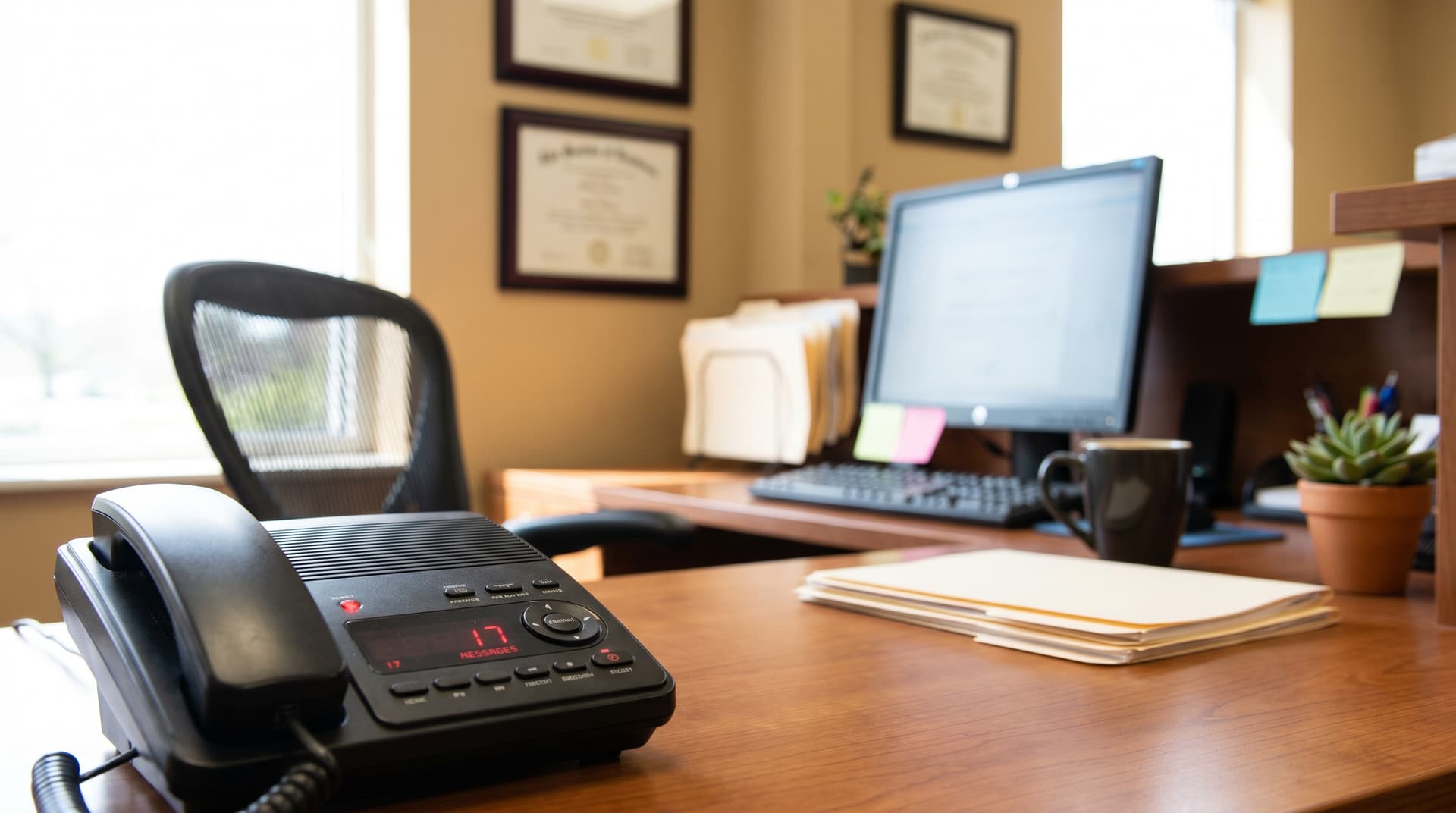
The phone rings and no one gets to it
Your front desk is good at their job. The problem is that Tuesday at 9 a.m. doesn't care. Three lines ring at the same time, someone's checking in a patient, and the hold music is already playing. A fourth caller hears ringing and ringing – and then voicemail. Most of them hang up. This article explains where those callers go, why they don't leave a message, and what VoxHealth does to catch them before they're gone.
Where missed calls actually go
When a caller hits your voicemail, you might assume they'll leave a message and you'll call back within the hour. Most don't.
They hang up and call the next practice on their list. That's not a complaint – it's just how people behave when they need an appointment and they're already on their phone. For dental patients with a toothache, for pet owners with a limping dog, for a dermatology patient trying to book before their deductible resets, waiting is not comfortable. The next practice that answers gets the appointment.
The call doesn't disappear from your phone log. It shows up as a missed call with no message, no name, and no way to know what that person needed. Most practices never follow up on those – there's nothing to go on.
Why callers don't leave voicemails
Voicemail made sense when returning a call was the only option. Now a person can text, book online, or call a competitor in 30 seconds. Leaving a message feels like submitting a form and hoping someone processes it eventually, so a lot of callers would rather hang up and try the next option than do it.
For healthcare practices specifically, the ask feels bigger. A caller might need to explain their situation, spell their name, leave a callback number, and then wait, with no idea when anyone will get back to them. A lot of people decide the effort isn't worth it, especially if they think the next call will just pick up.
What the agent does with an overflow call
That blank missed call – no name, no message, nothing to act on – is exactly what VoxHealth is built to prevent. When your front desk is on another line, or it's after hours, or it's a Saturday morning and no one is in, the agent picks up. It answers in seconds. It greets the caller the way you'd want your front desk to, using your practice name, in a calm and professional voice.
It keeps the caller on the line and has a conversation. It finds out what the caller needs: a new patient appointment, a prescription refill question, information about a service, or something else. But it doesn't stop at writing it down. The agent captures the full details – the caller's name, contact information, and the reason for the call – and then takes action on the request. It files the message where it belongs, categorized by what the caller needed, and sets the next step in motion, whether that's a follow-up task for the right person on your team or a step it can complete on its own. By the time your team is back at their desk, the request is already moving, not sitting in a queue waiting for someone to listen to it.
This is where a captured message beats a voicemail box. A voicemail is whatever the caller managed to get out before they lost patience, which is often a half-spelled name, a rushed phone number, and a vague reason that forces you to call back just to understand why they called the first time. The agent's message is the opposite. It confirms the spelling of the name, reads the callback number back to make sure it's right, and pins down exactly what the caller needs, so your team can act on it without a round of phone tag. Every message lands in one place and is organized by what the call was about, instead of sitting in a mailbox that someone has to dial into and transcribe by hand.
The caller feels handled instead of dropped, and your front desk starts the follow-up already knowing who called, how to reach them, and what they need.
Instant text-back so no one feels ignored
Capturing a clean message is only half the job. The other half is letting the caller know it landed, so right after the call ends the agent sends them a text message. The message confirms that their information was received and that someone from your practice will follow up. It takes about 5 seconds from the caller's perspective, and it changes the experience entirely.
This matters because the gap between "I called and got voicemail" and "I called and got a message saying my practice received my request" is a big one. The first feels like the call disappeared. The second feels like a practice that has its act together. Patients and clients notice that difference, and so does your online reputation over time.
Text-back is not the right tool for every situation, though. Read the next section before assuming it handles everything.
When a missed call still needs a human fast
The agent is honest about its limits, and you should be too when you set it up.
If a caller hangs up before the agent answers, because they were expecting a person and disconnected immediately, there's nothing to do. The agent can only help the callers who stay on the line long enough to have a conversation. If your practice sees a lot of hang-before-answer calls, that's worth knowing separately.
More importantly, a true emergency needs a person on the phone right now, not a message that says someone will follow up soon. A caller describing a dental abscess with facial swelling, a dog that isn't breathing, or a severe allergic reaction needs a human immediately. The agent can be set up to route calls like these: it recognizes urgent language and transfers to an on-call line or an emergency number right away. That routing has to be configured correctly, and it has to lead somewhere that a real person will actually answer.
Text-back is the right tool for the routine majority of calls: scheduling requests, general questions, and follow-ups. For the calls that are genuinely urgent, the right answer is a warm transfer to a human, and making sure that human picks up.
Run a free call audit
Every call your front desk can't get to is a patient deciding whether to wait for you or dial the next practice on their list. The difference between a structured message in your worklist tomorrow morning and a blank missed call you never knew to return usually comes down to whether anything picked up.
If you're not sure how many calls your practice is missing, or what those callers actually needed, a free call audit is a good place to start. VoxHealth will review your call patterns and show you where the gaps are, with no sales call required and no commitment.